


[2026] PEGACPDC25V1 by Pega Decisioning Consultant Actual Free Exam Practice Test
Free Pega Decisioning Consultant PEGACPDC25V1 Exam Question
NEW QUESTION # 34
U+ Bank has recently implemented Pega Customer Decision Hub. As a first step, the bank went live with the contact center to improve customer engagement. Now, U+ Bank wants to extend its customer engagement through the web channel. As a decisioning architect, you have created the new set of actions, the corresponding treatments, and defined a new trigger in the Next-Best-Action Designer for the new web channel.
What else do you configure for the new treatments to be present in the next-best-action recommendations?
- A. Change the generated decision strategy.
- B. No need to do anything. The strategy is auto-generated.
- C. Create a channel strategy specifically for web.
- D. Modify the Next-Best-Action Framework strategy to cater to the new web channel.
Answer: B
Explanation:
When you create a new trigger in the Next-Best-Action Designer, Pega Customer Decision Hub automatically generates a decision strategy for that trigger and channel. You do not need to create or modify any strategies manually. Verified References: Pega Academy - Decisioning Consultant - Creating triggers
NEW QUESTION # 35
U+ Bank wants to use Pega Customer Decision Hub to display a credit card offer, the Standard Card, to every customer who logs in to the bank website. What three of the following artifacts are mandatory to implement this requirement7 (Choose Three)
- A. An action and the associated web treatment.
- B. Real-time containers.
- C. Customer contact policies.
- D. Customer engagement policies.
- E. A business structure.
Answer: A,B,E
Explanation:
To implement this requirement, you need to create an action and the associated web treatment, a real-time container, and a business structure. An action is a proposition that you want to present to a customer, such as a credit card offer. A treatment is the way you present the action to a customer, such as an image or a text message. A real-time container is a configuration that defines how to deliver actions and treatments to a specific channel, such as a website or a mobile app. A business structure is a hierarchy of business groups and business issues that organizes actions into meaningful categories. Verified References: Pega Academy - Decisioning Consultant - Creating actions and treatments, Pega Academy - Decisioning Consultant - Configuring real-time containers, [Pega Academy - Decisioning Consultant - Defining business structure]
NEW QUESTION # 36
U+ Bank, a retail bank, has recently implemented a project in which qualified customers see mortgage offers when they log in to the web self-service portal.
Currently, only the customers who satisfy the following engagement policy conditions receive the Fifteen- year fixed-rate mortgage offer:
The bank decides to make two changes:
1. Update the suitability condition for the Fifteen-year fixed-rate mortgage offer.
2. Introduce a new offer , Twenty-year fixed-rate mortgage.
The following table shows the new engagement policy conditions for both mortgage offers:
What is the best practice to fulfill this change management requirement in the Business Operations Environment?
- A. Create a single change request in the 1:1 Operations Manager portal.
- B. Create two change requests: one in the Pega Customer Decision Hub portal and the other in the 1:1 Operations Manager portal.
- C. Create a single change request in the Pega Customer Decision Hub portal.
- D. Create two change requests in the 1:1 Operations Manager portal.
Answer: A
Explanation:
According to the best practice, a single change request should be created in the 1:1 Operations Manager portal, because both changes are related to the engagement policies and propositions that are managed in this portal. The Pega Customer Decision Hub portal is used to design and test the decision strategies, not the engagement policies and propositions. Verified References: Pega Decisioning Consultant | Pega Academy
NEW QUESTION # 37
U+- Bank uses Next-Best-Action Designer to configure engagement policies for different customer segments.
A business user wants to create reusable policy conditions that can apply across multiple actions and campaigns. The user must understand when the save-to-library feature is available.
When is the save-to-library option unavailable for engagement policy conditions?
- A. When the business user configures the conditions at the action level.
- B. When the business user configures the conditions with strategy rules or parameterized When conditions.
- C. When the business user applies conditions to group-level policies.
- D. When the business user configures the conditions with arbitration parameters.
Answer: B
NEW QUESTION # 38
U+ Bank, a retail bank, introduced a new mortgage refinance offer in the eastern region of the country. They want to advertise this offer on their website by using a banner, targeting the customers who live in that area.
What do you configure in Next-Best-Action Designer to implement this requirement?
- A. A customer segment
- B. An audience
- C. A prioritization formula
- D. Applicability rules
Answer: D
NEW QUESTION # 39
In a decision strategy, you can use aggregation components to____________.
- A. filter actions based on priority and relevance
- B. choose between actions
- C. set a text value to a strategy property
- D. make calculations based upon a list of actions
Answer: D
Explanation:
Aggregation components are used to perform calculations on a list of actions, such as sum, average, count, minimum, or maximum. For example, you can use an aggregation component to calculate the total value of all the actions in a group. Verified References: Pega Academy - Decisioning Consultant - Aggregating actions
NEW QUESTION # 40
A bank has been running traditional marketing campaigns for many years. One such campaign sends an offer email to qualified customers on day one. On day five, the bank presents a similar offer if the first email is ignored.
If you re-implement this requirement by using the always-on outbound customer engagement paradigm, how do you approach this scenario?
- A. Configure a primary schedule for the original offer email and setup an ad-hoc schedule to send the second email.
- B. Create two segments to identify the target audience for each of the two offer emails: day one, and day five. Set up two schedules per day for the two segments.
- C. Create an action with a flow that contains two Send Email shapes, one for each email. Set appropriate wait times between the shapes.
- D. Configure the primary schedule to run daily and let the artificial intelligence (AI) choose the best action based on engagement policies.
Answer: D
Explanation:
The always-on outbound customer engagement paradigm relies on AI to select the best action for each customer at any given time, based on their profile, context, and behavior. You do not need to create separate segments or schedules for different offers or timings. You can configure the primary schedule to run daily and let the AI choose the best action based on engagement policies, such as contact policies, eligibility rules, suitability rules, and arbitration. The AI will also learn from the customer responses and optimize the action selection over time.
NEW QUESTION # 41
U+ Bank, a retail bank, has recently implemented a project in which credit card offers are presented to qualified customers when they log in to the web self-service portal The Dank added engagement policy conditions to show the offers based on the bank's requirements.
In the Answer Area, select the correct engagement policy for each condition.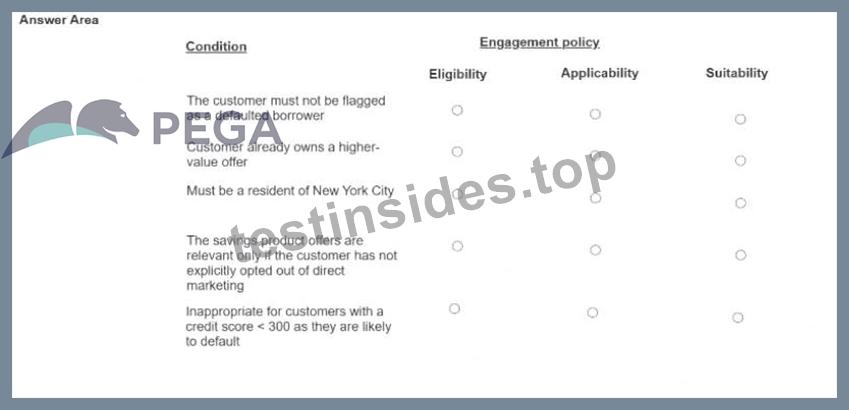
Answer:
Explanation: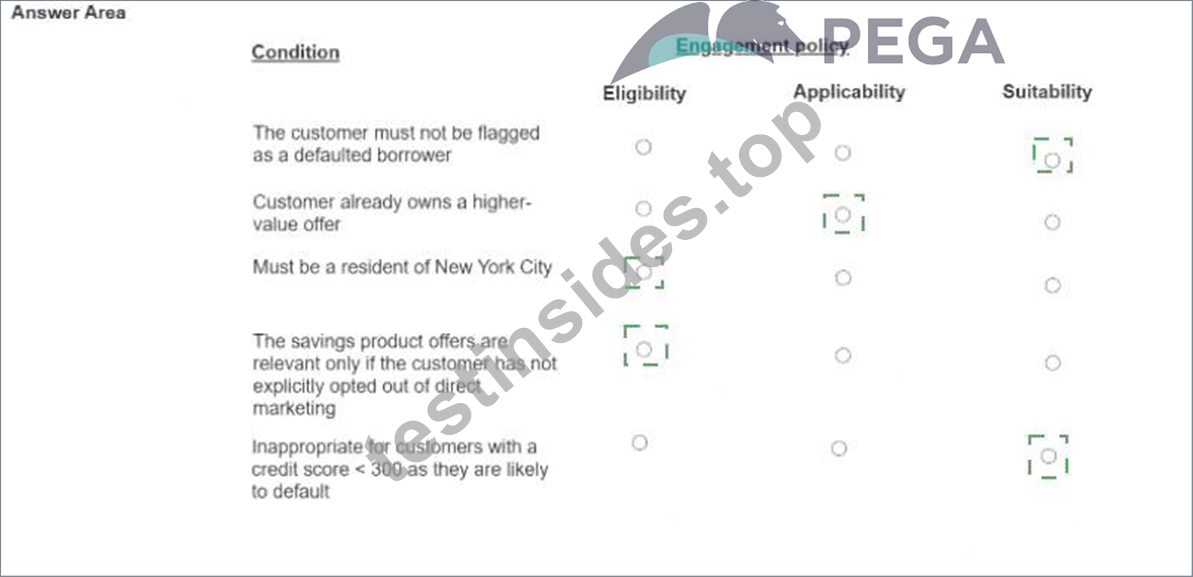
Explanation: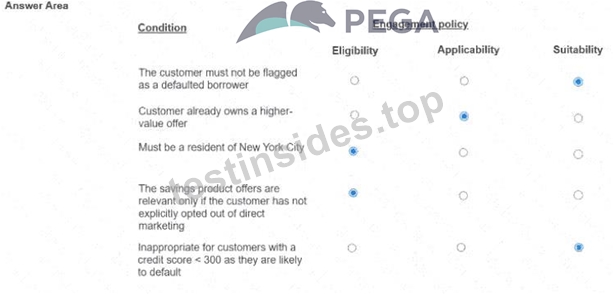
NEW QUESTION # 42
Regional Bank experiences an unexpected system outage affecting online banking services across multiple locations. The bank needs to immediately inform all customers about the temporary service disruption and provide alternative banking options. The communication must reach every customer simultaneously and should not be repeated.
Which communication approach should the bank use to address this urgent customer notification requirement?
- A. Create a one-time action to deliver Immediate batch communication to all customers
- B. Send individual personalized messages through the standard outbound schedules
- C. Schedule a regular always-on outbound communication with engagement policies
- D. Configure a promotional campaign with targeted audience segmentation rules
Answer: A
NEW QUESTION # 43
MyCo, a telecom company, wants to Include offer-related images in the emails that they send to their qualified customers. As a decisioning architect, what best practice do you follow to include images in emails?
- A. Provide links to images In the email.
- B. Attach images to the email.
- C. Host images on an external server.
- D. Directly embed images in the email.
Answer: C
NEW QUESTION # 44
The development team at U+Bank wants to create multiple test personas for their new engagement strategy quickly. A team member suggests using Pega GenAI features instead of creating a manual persona to improve efficiency and speed up the testing process.
Which advantage does Pega GenAI provide when creating personas compared to manual creation?
- A. Pega GenAI automatically builds engagement policies for every persona it creates.
- B. Pega GenAI creates personas that do not require validation or review after generation.
- C. Pega GenAI allows describing persona traits by using natural language to speed up creation.
- D. Pega GenAI removes the need to configure channel context during persona testing.
Answer: C
NEW QUESTION # 45
U+ Bank wants to use Pega Customer Decision Hub to show the Reward Card offer on its website to the qualified customers. In preparation, the action, the treatment, and the real-time container are already created.
As a decisioning architect, you need to verify the configurations in the Channel tab of the Next-Best-Action Designer to enable the website to communicate with Pega Customer Decision Hub.
To achieve this requirement, which two tasks do you ensure are complete in the Channel tab of the Next-Best- Action Designer? (Choose Two)
- A. Add contact policy rules.
- B. Map the real-time container to a business structure level.
- C. Define the starting population.
- D. Enable a web channel.
Answer: B,D
Explanation:
To achieve this requirement, you need to ensure that two tasks are complete in the Channel tab of the Next- Best-Action Designer: enable a web channel and map the real-time container to a business structure level. A web channel is a type of channel that allows you to deliver actions and treatments to your customers through your website or web app. You need to enable a web channel and configure its settings, such as authentication, security, and response format. A real-time container is a configuration that defines how to deliver actions and treatments to a specific channel. You need to map the real-time container that contains the Reward Card offer to a business structure level, such as Top-level or Issue-level, so that it can be available for delivery through the web channel. Verified References: [Pega Academy - Decisioning Consultant - Configuring channels],
[Pega Academy - Decisioning Consultant - Configuring real-time containers]
NEW QUESTION # 46
U+ Bank follows all engagement policy best practices to present credit card offers on their website. The bank has introduced a new credit card offer, the Rewards card. Anna, an existing customer, currently holds a higher value card, Premier Rewards, and does not see the new Rewards card offer.
What condition possibly prevents Anna from seeing the new Rewards card offer?
- A. Suppression rules
- B. Suitability
- C. Eligibility
- D. Applicability
Answer: A
Explanation:
Suppression rules are used to prevent customers from seeing offers that are not relevant or appropriate for them. For example, if a customer already has a higher value card, they should not see a lower value card offer.
Therefore, suppression rules are the most likely condition that prevents Anna from seeing the new Rewards card offer. Verified References: [Pega Decisioning Consultant | Pega Academy]
NEW QUESTION # 47
The following decision strategy outputs the most profitable shoe a retailer can sell. The profit is the selling Prices of the shoe, minus the Cost to acquire the shoe.
The details of the shoes are provided in the following table:
The details of the shoes are provided in the following table: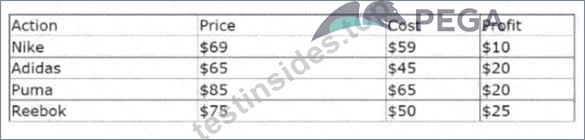
To output the most profitable shoe, which component do you add in the blank space that is highlighted in red?
- A. Filter
- B. Prioritize
- C. Decision table
- D. Group By
Answer: B
Explanation:
To output the most profitable shoe, you need to add a Prioritize component in the blank space. A Prioritize component allows you to rank actions based on one or more properties. In this case, you can rank the shoes based on the Profit property and select the highest ranked shoe as the output. Verified References: Pega Academy - Decisioning Consultant - Prioritizing actions
NEW QUESTION # 48
U+ Bank, a retail bank, is designing an engagement policy for its credit card promotions. To meet legal requirements, the bank must ensure that only customers aged 18 or older are considered for any credit card offer.
Which policy configuration level should U+ Bank use to implement the age requirement (18+ years) for all credit card promotions?
- A. Action-level policy
- B. Suitability condition
- C. Group-level policy
- D. Applicability condition
Answer: C
NEW QUESTION # 49
MyCo, a telecom company, wants to introduce a new group of offers called Tablets for all customers. As a decisioning architect, which two valid actions do you create? (Choose Two)
- A. 5% discount on the price
- B. Netflix subscription for 12 months
- C. Tablet serial number
- D. Tablet operating system
Answer: A,D
NEW QUESTION # 50
MyCo, a telecom company, uses Pega Customer Decision Hub to present offers to qualified customers. The business recently decided to send offer messages through the email channel. The Design department has designed an email treatment which includes dynamic placeholders.
As a deaccessioning architect, what do you use in order to test the visualization and the rendering of the email content, including replacing of the placeholders with customer information?
- A. A list of customer email addresses from the Test email tab
- B. Preview section from the email content editor
- C. Schedule an outbound run with a limited number of customers
- D. A seed list from the Test email tab
Answer: D
Explanation:
To test the visualization and the rendering of the email content, including replacing of the placeholders with customer information, you use a seed list from the Test email tab. A seed list is a predefined set of customers that you can use to test your email treatments before sending them to your target audience. You can select one or more customers from the seed list and send them a test email with your treatment. You can then verify how the email looks in their inbox and how the placeholders are replaced with their actual values. Verified References: [Pega Academy - Decisioning Consultant - Testing email treatments]
NEW QUESTION # 51
As shown in the following figure, decision strategy contains 'Green Label' and 'Black Label' Proposition components that point to the "Set Printing Cost' Set Property component that uses 'BaseCost' and
"LetterCount." The configuration of the Prioritize component selects the lowest cost. What is the role of the Set Property component in the following decision strategy?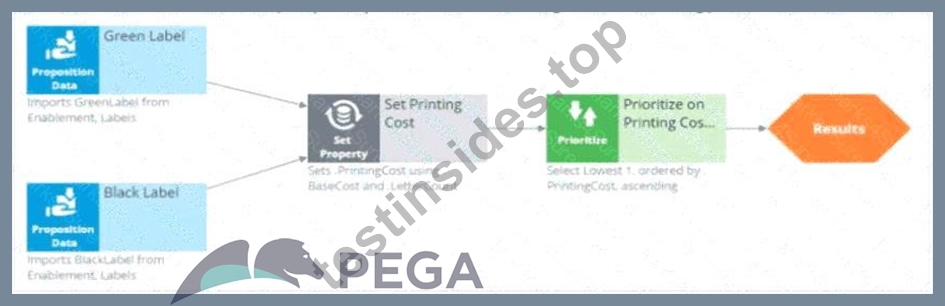
- A. To calculate the printing cost for each of the actions.
- B. To filter actions based on the printing cost.
- C. To create a new strategy property.
- D. To import the printing cost property into the strategy.
Answer: A
NEW QUESTION # 52
MyCo, a mobile company, uses Pega Customer Decision Hub to display offers to customers on its website.
The company wants to present more relevant offers to customers based on customer behavior. The following diagram is the action hierarchy in the Next-Best-Action Designer.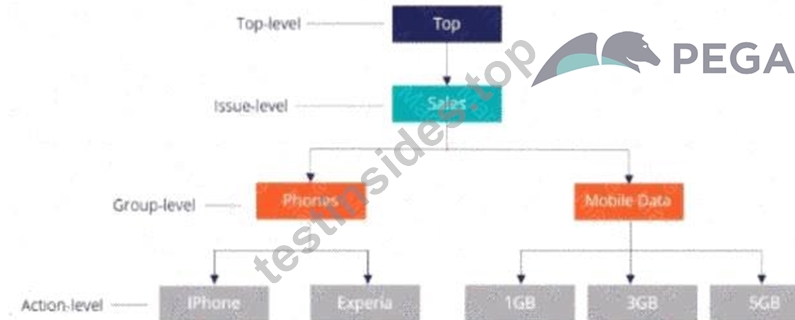
The company wants to present offers from both the groups and arbitrate across the two groups to select the best offer based on customer behavior.
As a decisioning architect, what must you do to present offers from the two groups?
- A. Set contact limits for both the groups.
- B. Enable an engagement policy for the second group.
- C. Create a decision strategy at the Issue-level
- D. Map a real-time container to the Top-level or Issue-level.
Answer: D
Explanation:
To present offers from the two groups, you must map a real-time container to the Top-level or Issue-level. A real-time container is a configuration that defines how to deliver offers and treatments to a specific channel, such as a website or a mobile app. By mapping a real-time container to the Top-level or Issue-level, you can enable all the offers under that level to be available for delivery through that channel. Verified References: Pega Academy - Decisioning Consultant - Configuring real-time containers
NEW QUESTION # 53
U+Bank presents various credit card offers to Its customers on Its website. The bank uses AI to prioritize the offers according to customer behavior. After the introduction of the Gold credit card offer, the offer click- through propensity decreased to 0.42.
What does the decrease in the propensity value most likely indicate?
- A. Similar customers purchase other offers.
- B. Similar customers ignore the offer.
- C. Similar customers do not qualify for the offer.
- D. Similar customers show interest in the offer.
Answer: B
NEW QUESTION # 54
......
Pegasystems PEGACPDC25V1 Actual Questions and Braindumps: https://www.testinsides.top/PEGACPDC25V1-dumps-review.html
PEGACPDC25V1 dumps & Pega Decisioning Consultant sure practice dumps: https://drive.google.com/open?id=1da0He4i2lL25SDijQecUSyenzq9AcE1b